

I have devoted several previous KineSophy articles to arguing why and how physical fitness fits into a unifying ethical theory. All things being equal, it is better to be more physically fit than less—and not just because of the individual health benefits. Physical fitness gives an individual the capacity to do more in commonly recognized realms of ethics like generosity. But perhaps I was getting ahead of myself. After all, the fields of ethics and morality would be very limited without a discussion of physical human bodies. Actions are moral or immoral to the extent that they respect or harm real-life beings. But what qualities must a physical object possess to be worthy of ethical consideration? Is there a foundational characteristic shared by moral beings? In this article, I draw on the work of philosophers Luce Irigaray and René Descartes to show the link between a breathing, physical body and morality and argue that breath is the foundation of ethics.
Irigaray and Breath
In a 2024 interview published in the magazine Philosophy Now, philosopher Luce Irigaray describes how the COVID-19 pandemic affected our perception of breath and touch:
“It would be preferable to think about the practice of breathing as a culture of life, and air as that which unites all living beings, and touch as the first and most fundamental means of communication and communion between us [rather than as things to be feared].”
Lamenting that these central themes of her work became stigmatized during the pandemic, Irigaray continues:
“Air is the element most essential to life. Alas, our culture considers eating rather than breathing as that which primarily makes our existence possible; and while materialists focus their attention on the need to eat and the money that this requires, they worry very little about the need to breathe, which is even more fundamental, and is, in a way, free.”
Later, she adds:
“Breathing is first of all the condition for our autonomy and our individuation: to be born is to breathe by oneself. It is also what most universally unites us with other living beings. Breathing is thus at once what separates and unites us with the world and with the other(s).”
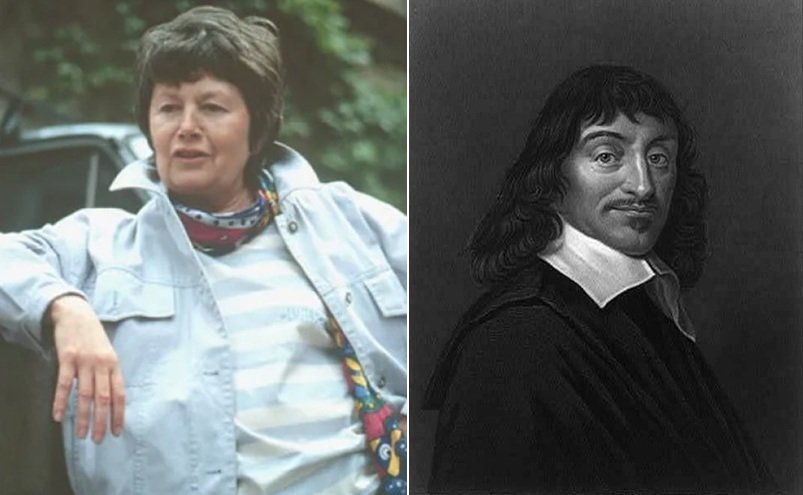
Descartes’s Foundation
While I’m not familiar with Irigaray’s total body of work, I’m struck by the parallel between her description of the foundational nature of breath and René Descartes famous “cogito, ergo sum.” Seeking to discover the unshakable pillars upon which he could build his philosophy, Descartes observed it was possible he might be deceived in his sensory experience of the world. After all, he often had dreams he mistook for reality. How could he be certain he was not dreaming at any particular moment? How could he know the experiences he perceived were really happening to his body and were not just an unconscious hallucination?
For that matter, there might be a powerful evil demon deceiving him all the time. Contemporary skeptics have suggested we might be disembodied brains floating in a vat of nutrient-rich chemicals with electrodes stimulating what appears to be conscious experience. Perhaps we only exist in a computer simulation. Perhaps we are living in the world of The Matrix.
But in what I consider one of the essential conclusions in all of philosophy, Descartes asserted that even if he were deceived about all else, there must be something, namely himself, being deceived. He might be dreaming or a brain in a vat, but he must exist in some fashion. I doubt, I think; therefore, I exist.
Overcoming Skepticism
It’s hard to argue your way out of the depths of Cartesian skepticism. I find Descartes’s attempt to use his breakthrough to reclaim the external world unconvincing. Because how could I tell if I were a brain in a vat? How can I prove that my conscious experience of the world reflects reality? How do I know it is not merely the effect of electrodes stimulating the appropriate parts of my envatted brain? Philosophers often brush aside this concern in order to deal with pressing issues like ethics and the meaning of life. After all, in order to argue about how we should treat other people, we must first assume that other people exist and that our actions impact them in some way.
In his 1939 essay Proof of an External World, philosopher G.E. Moore offered a common sense retort to Cartesian skepticism, “by holding up my two hands, and saying, as I make a certain gesture with the right hand, ‘Here is one hand’, and adding, as I make a certain gesture with the left, ‘and here is another.’” Being certain he possessed two hands external to his mind, Moore concluded an external world exists. And (aside from Descartes’s cogito), what could be more certain that the two hands that have been with me my whole life really do exist?

Breathing Bodies
My college philosophy thesis addressed arguments against skepticism, but I don’t recall them well enough now to bore you with them here. The point I want to make now is that the entire KineSophy project has assumed, à la Moore, that we have physical bodies that exist in a physical world. I wouldn’t get very far in the life I experience if I seriously entertained the skeptical position at every moment of the day.
In the morning, I would experience waking up from a dream and wonder if I was still dreaming. I would lie there pondering how I could tell for sure if I was dreaming or not. Years later, I would be rotting in my bed, having never worked out whether my pangs of hunger and thirst were real or illusory. And it’s fruitless to discuss the philosophy of human movement without believing I have a physical body capable of movement.
But if we have physical bodies, then Irigaray is right that breath is the defining feature of that existence. A newborn infant is physically alive the moment it draws its first breath, not the moment its eyes take in the hazy surroundings of the delivery room or its mouth roots for its mother’s breast. I breathe; therefore, I am embodied. My body is alive because I breathe. All other physical needs are secondary.
And as Irigaray observes, breathing separates and unites us with the world and with others. It separates us because only I can breathe for myself. It unites us because I observe that others have the same fragile relationship with breath that I do. Others exist because, like me, they breathe. Like me, they cease to exist when their breath stops.
The Foundation of Ethics
This observation makes breath, along with thought, the foundation of ethics. The most obvious beings worthy of moral consideration are those that breathe and think. And we intuitively prioritize breath over thought. There is much debate now about whether artificial intelligence is worthy of moral consideration. There is little debate that humans with mental disabilities are worthy of such consideration.
I breathe, and I wish to keep breathing. I see that others have bodies that breathe. From the way they move those bodies, I assume they have minds like mine to direct those movements and that they desire to continue breathing. And this point is the first piece of a moral framework. Because I think and breathe, there are ways I wish to be treated. I have rights I do not wish violated. To violate the desires and rights of another thinking, breathing creature is to sanction an equivalent violation of my rights, which I do not want. Therefore, I ought to respect the rights of others. Breath supports physical existence, which supports morality.
Like Descartes, Irigaray has picked out a foundational aspect of existence. Unlike Descartes, the aspect of breath unites living creatures instead of limiting them to isolated introspection. Thinking means I exist as a mind with an undetermined form. Breathing means I exist as a physical body. Observing that others breathe and using my rational capabilities, I arrive at the genesis of moral thought.